An 8-minute read for project managers, programme directors, and digital leaders thinking seriously about what AI changes — and what it doesn't.
Let’s start with the reassuring part.
AI is not going to replace project managers. Not the good ones. Not any time soon.
Leading complex change through organisations full of competing priorities, uncertain information, and human beings with both legitimate interests and irrational behaviours is not something a language model is about to automate away.
That reassurance is real.
But it is also the least interesting part of the conversation.
The more important reality is this:
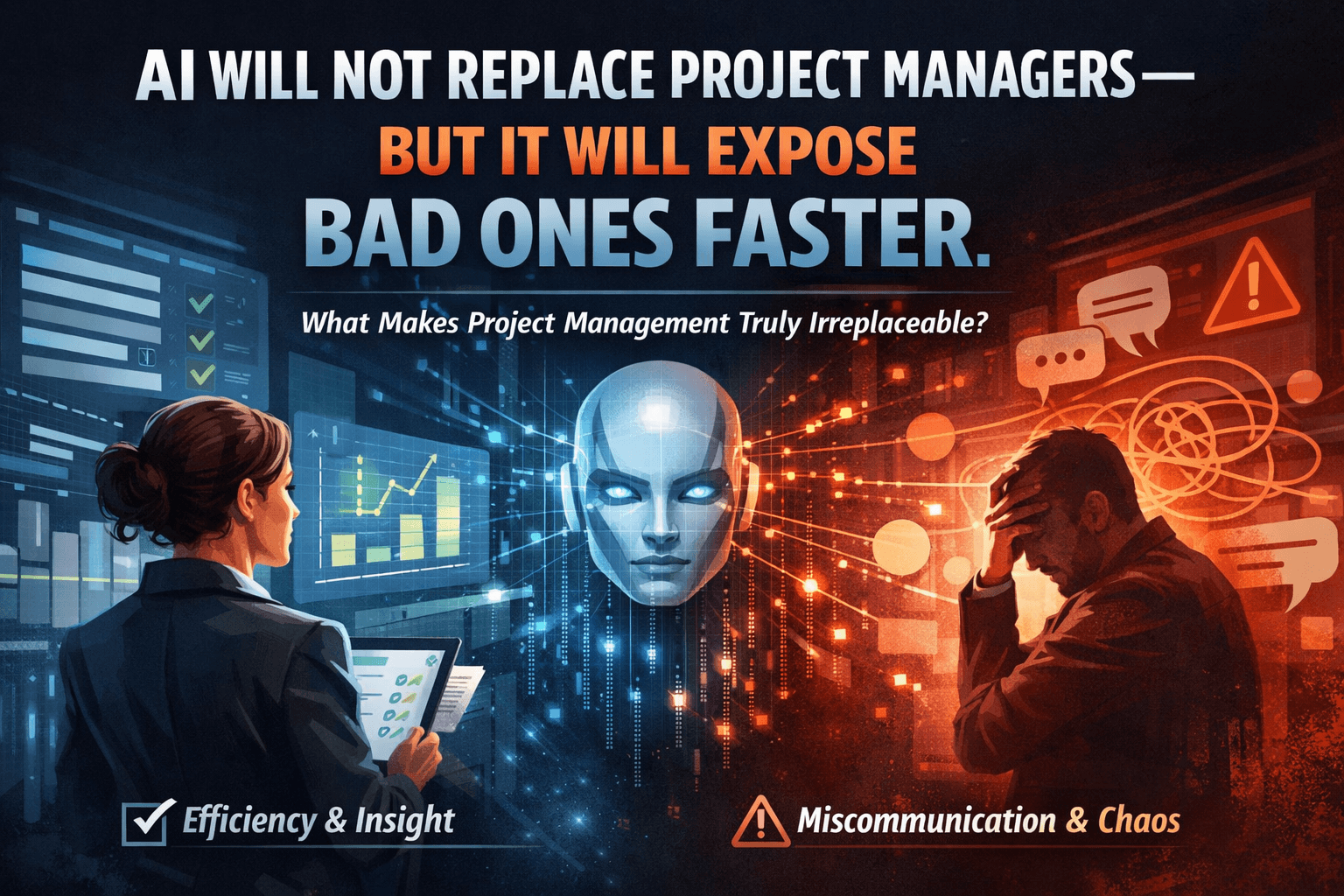
AI will not replace project managers — but it will expose weak ones faster.
Not because the role disappears, but because the parts of project management that AI does well are precisely the parts that have historically allowed weak practice to hide.
When status reports write themselves, risks are surfaced automatically, schedules update dynamically and stakeholder communications can be drafted in seconds, the administrative scaffolding of project management begins to fall away.
What remains is the part AI cannot do.
Judgement.
Leadership.
Trust.
The ability to read a room, challenge a sponsor, and hold a delivery team together through ambiguity that no dashboard can resolve.
For strong project managers, this shift is liberating.
For those whose value has been primarily coordinative rather than leadership-oriented, it is a different moment entirely.
Before discussing what AI cannot replace, it is worth being clear about what it already does well.
The capabilities are real, and the implications for programme delivery are significant.
AI excels at pattern recognition across large datasets. In project terms, that means identifying early warning signals in schedules, cost trajectories and resource utilisation that human project managers often miss while juggling multiple workstreams.
It can correlate risk indicators across programmes, identify projects that appear green but match historical failure patterns, and surface issues earlier than traditional reporting cycles allow.
AI is also highly effective at generating structured communication.
Status reports.
Meeting summaries.
Risk logs.
Change documentation.
Much of the documentation burden that consumes a project manager’s week can now be dramatically reduced. Human judgement still matters, but the production effort is falling quickly.
AI is also capable of scenario modelling. Questions that once required hours in planning tools can increasingly be explored conversationally:
What happens to the critical path if a dependency slips two weeks?
What are the resource implications of accelerating this workstream?
Finally, AI is extremely effective at holding institutional memory.
It can analyse historical programmes, lessons learned, delivery patterns and past risk events across an organisation in ways human teams rarely sustain. People move roles. Context disappears. AI systems do not forget.
These capabilities matter.
Organisations that deploy them well will run programmes with better information, faster decision cycles and significantly lower administrative overhead.
Project managers in that environment will have better tools and more visibility than ever before.
They will also have nowhere to hide.
For years, there has been a version of project management that operates primarily at the coordination layer.
Scheduling meetings.
Chasing actions.
Maintaining RAID logs.
Producing reports.
Updating plans.
None of this work is worthless. Coordination matters, and programmes without someone maintaining operational discipline quickly lose structure.
But coordination is not the same thing as leadership.
And for a long time, the coordination layer has provided effective camouflage for practitioners who are very good at process management but substantially weaker at the leadership aspects of delivery.
AI targets the coordination layer first.
When the status report writes itself, the difference between coordination and leadership becomes visible.
The project manager who has been interpreting information, exercising judgement and shaping narratives for decision-makers becomes more effective. AI removes production effort and creates more space for thinking.
The project manager whose value has primarily been producing the report finds that the report still exists — it simply no longer requires them to create it.
This observation is uncomfortable, but it is also honest.
And it is far better to confront it now than to discover it unexpectedly in a performance review three years from now.
If coordination becomes increasingly automated, what remains at the centre of project management?
Three capabilities sit beyond what AI can meaningfully replicate in real programme environments.
AI is excellent at analysing structured information.
It is far less capable when the information itself is unreliable or incomplete.
Real programmes are full of these situations.
The team reporting green because they do not feel safe reporting amber.
The dependency everyone knows is at risk but nobody has formally escalated.
The sponsor who says the right things in governance but privately doubts the programme.
Understanding what is really happening requires contextual intelligence, organisational awareness and experience.
Those are human capabilities.
Some of the most important programme work happens in conversations that never appear in project artefacts.
The discussion with a workstream lead whose optimism is drifting into denial.
The challenge to a senior stakeholder whose political decision is undermining delivery.
The honest conversation with a sponsor about whether the business case still holds.
These conversations require authority, trust and interpersonal skill.
AI can surface the data that suggests a conversation is needed.
It cannot have the conversation.
Every major programme eventually encounters a moment where confidence breaks.
A missed milestone.
A technical failure.
A critical dependency collapsing.
These are not data problems.
They are human problems.
The project manager who stabilises the team, rebuilds stakeholder confidence and establishes a credible path forward is doing something no AI tool can replicate.
This is leadership.
What AI will expose is a distinction the profession has often avoided making clearly.
The difference between coordination and leadership.
Coordination keeps the delivery machine running.
Tracking. Reporting. Scheduling. Documenting.
Leadership is something different entirely.
It is the work of making difficult judgements with incomplete information, building trust across complex stakeholder groups and taking accountability for outcomes when accountability is uncomfortable.
For much of the history of the profession, these two capabilities have been bundled together under the label of project management.
AI removes that ambiguity.
When coordination becomes increasingly automated, leadership becomes the primary visible output of the role.
And that is ultimately healthy for the profession.
For professionals at different stages of their career, the implications are clear.
Build your technical foundation, but invest heavily in the skills AI cannot replicate.
Stakeholder management.
Communication.
Organisational awareness.
Difficult conversations.
These capabilities will define your career far more than scheduling proficiency.
Be honest about where your value actually sits.
Are you primarily coordinating activity, or are you exercising leadership and judgement?
The answer should guide how you spend your development time over the next few years.
The shape of delivery organisations will change.
AI reduces the need for coordination-heavy roles and increases demand for leaders capable of navigating complexity.
That means different hiring criteria, different development pathways and different performance expectations.
Organisations that plan for this transition will have a significant advantage over those that discover it accidentally.
Here is the genuinely reassuring conclusion.
AI will not replace project managers.
But it will redefine what project management means.
The version of the role that survives and thrives is the one that was always the most valuable: the leader who can navigate ambiguity, build trust, make difficult decisions and guide organisations through change.
AI simply removes the administrative weight that has historically obscured that work.
The AI is not coming for project managers.
It is coming for the parts of project management that were never really the point.
Which parts of project management do you believe are truly irreplaceable — and which are more automatable than we might like to admit?