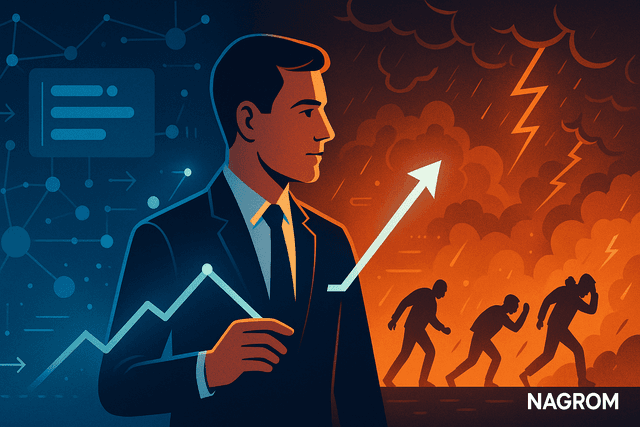

There was a time when a well-written status report was considered evidence of good project management. Clear traffic lights, carefully chosen wording, and a reassuring sense that everything was under control were not just expected, they were rewarded.
That time has quietly passed.
Modern delivery environments generate far more data than any individual can manually summarise. Commits, deployments, cycle times, decision logs, risks, incidents and dependencies leave digital traces whether we report on them or not. AI does not need to be told what is happening; it observes continuously. And that changes the definition of competence.
In an AI-enabled delivery environment, the question is no longer “have you reported the issue?” but “did you see the signal early enough to act?”. This is an uncomfortable shift for many organisations because it removes the protective layer that reporting used to provide. If the data was already there, the excuse of not knowing becomes harder to justify.
Signal detection is about recognising emerging patterns before they harden into problems. A gradual increase in rework. A subtle slowdown in decision approvals. A dependency that technically exists but has not yet been acknowledged as a risk. AI excels at surfacing these weak signals, but only if teams are willing to look beyond red, amber and green.
This is where delivery maturity is tested.
Good delivery is no longer about producing artefacts on time. It is about creating feedback loops that are tight enough to support judgement in real time. Leaders who thrive in this environment learn to engage with probability rather than certainty. They accept that early warnings are, by definition, incomplete and sometimes wrong. They understand that acting earlier, even with imperfect information, is often safer than waiting for confirmation.
The cultural impact of this shift is significant. Teams used to retrospective explanations must adjust to proactive conversations. Stakeholders accustomed to firm dates must learn to interpret ranges and confidence levels. Trust becomes rooted not in optimism, but in transparency.
There is also a subtle behavioural change that matters. When teams know that systems are watching continuously, the incentive to “manage the narrative” fades. What replaces it is a focus on managing reality. This is uncomfortable at first, but ultimately healthier.
Nagrom’s work in this space often centres on helping organisations move from retrospective reporting to forward-looking awareness. Not by overwhelming teams with dashboards, but by helping them decide which signals actually matter in their context. Technology enables the shift, but judgement sustains it.
As AI becomes more deeply embedded in delivery platforms, the organisations that succeed will not be the ones with the most data, but the ones that learn to listen differently. Status reports will not disappear overnight, but they will slowly lose their central role. In their place, signal detection becomes the quiet discipline that separates reactive teams from resilient ones.