There are few terms in business more confidently misused than “programme” and “project”. Add “portfolio” into the conversation and even experienced professionals occasionally hesitate. Everything feels connected to change. Everything involves investment. Everything seems important. Yet these three concepts are not interchangeable.
The distinction is not academic. It determines how decisions are made, how money is allocated, how risk is managed and ultimately whether strategy becomes reality or remains a slide in a board deck.
This article sets out to clarify the differences in practical, human terms. We will define each concept clearly, explore how they connect, and examine the governance requirements that sit at each level. By the end, the hierarchy should feel intuitive rather than abstract.
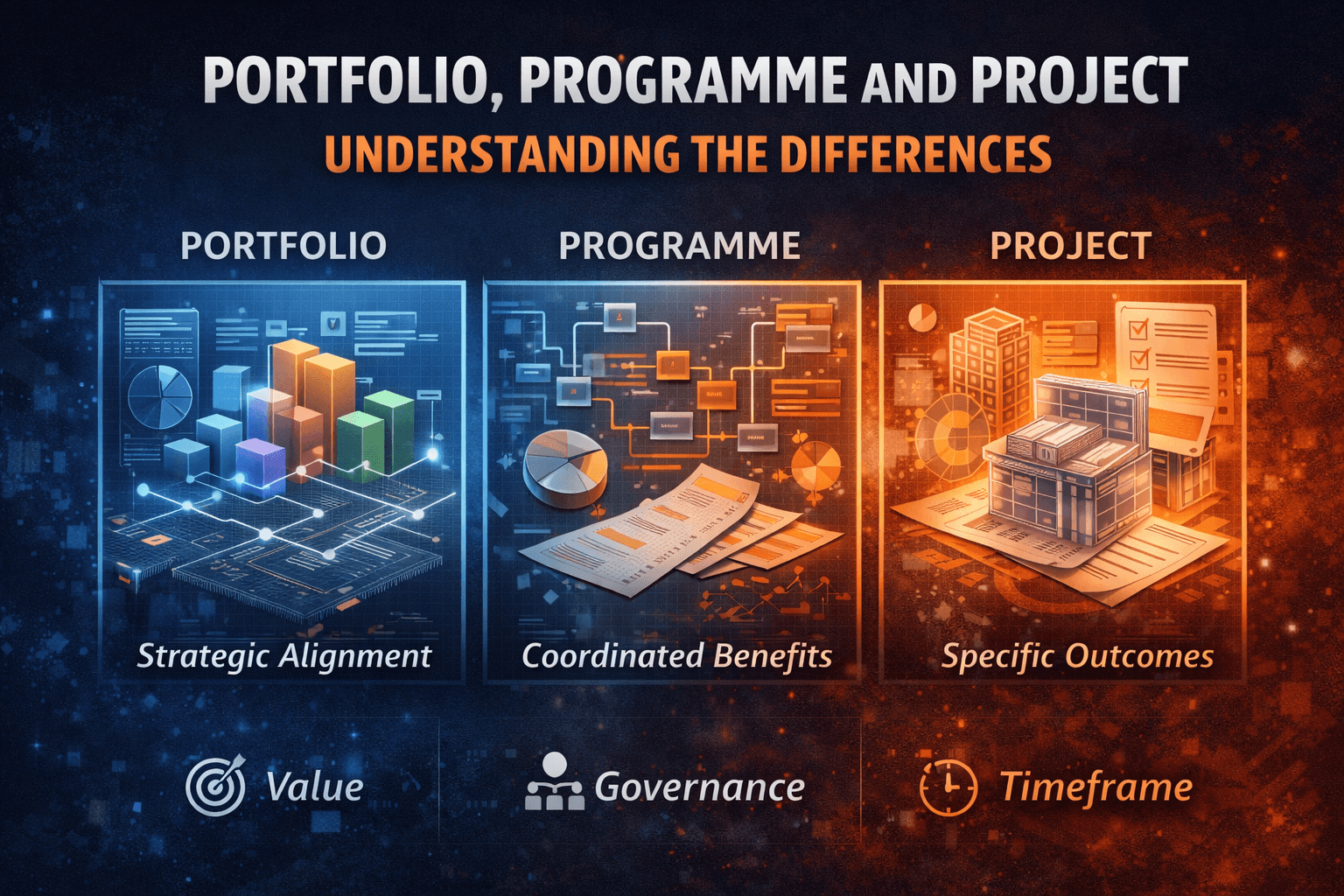
It helps to visualise change in three layers.
Each layer serves a different purpose. Each operates at a different altitude. And each demands a different governance approach.
Confusion arises when organisations attempt to manage all three in the same way.
A project is a temporary endeavour undertaken to create a unique product, service or result.
Temporary means it has a defined start and end.
Unique means it is not routine operational work.
Endeavour means it requires coordinated effort.
Building a new website, implementing a finance system, launching a product or redesigning a process are all projects. They are focused, bounded and outcome-driven.
Projects deliver outputs. They produce something tangible: a system, a building, a report, a new capability. They operate within constraints of time, cost and scope.
A project can be executed well or badly. It can be on time or late. It can be within budget or wildly off course. But it is fundamentally about delivery.
What it is not responsible for, at least not alone, is strategic transformation. That responsibility sits one level higher.
Project governance is execution-focused. It exists to ensure disciplined delivery.
At this level, governance typically addresses five core concerns:
Project governance mechanisms commonly include stage gates, sponsor oversight, formal change control, risk and issue logs, and regular performance reporting.
It is detailed. It is structured. It is close to the work.
The purpose is predictability.
If project governance becomes too heavy, delivery slows. If it becomes too light, control evaporates. The balance is operational discipline without unnecessary bureaucracy.
A programme is a group of related projects managed in a coordinated way to achieve outcomes and benefits that would not be realised if the projects were managed independently.
The critical word here is “related”.
Projects inside a programme share dependencies, sequencing logic, resource constraints or benefit realisation goals. Their combined impact produces something greater than the sum of individual outputs.
For example, a digital transformation initiative might include:
Each project delivers an output. Together, they deliver improved customer experience, increased revenue or operational efficiency.
A programme is therefore benefit-focused rather than output-focused.
Projects deliver things.
Programmes deliver change.
Programme governance operates at a different altitude. It must manage integration, sequencing and benefit realisation.
The questions shift:
Programme governance often includes a Senior Responsible Owner accountable for outcomes, a benefits realisation framework, cross-project dependency management and integrated risk oversight.
Unlike projects, programmes must tolerate ambiguity. Strategy evolves. Market conditions shift. Assumptions are tested. Governance at this level must enable adaptation without losing control.
If project governance is about delivering correctly, programme governance is about delivering coherently.
A portfolio is the total set of change initiatives managed collectively to achieve strategic objectives.
It is defined not by dependency, but by investment logic.
Projects and programmes within a portfolio may be unrelated in delivery terms. One might focus on regulatory compliance. Another on product innovation. Another on cost reduction.
What binds them together is strategy and resource competition.
The portfolio answers a fundamentally different question:
Are we investing in the right things?
While projects manage execution and programmes manage outcomes, portfolios manage capital allocation and strategic balance.
Portfolio governance is strategic and financial in nature.
Its focus is not on task-level performance, but on alignment, risk exposure and return on investment.
Key portfolio governance concerns include:
Portfolio governance mechanisms often involve executive investment committees, prioritisation frameworks, financial modelling and strategic review cycles.
It is less concerned with whether a specific milestone is delayed by two weeks and more concerned with whether continued investment supports long-term objectives.
If project governance asks “Are we building it correctly?”
Programme governance asks “Are we achieving the intended outcome?”
Portfolio governance asks “Should we be building it at all?”
That distinction is decisive.
In a mature organisation, the layers connect seamlessly.
Strategy informs portfolio priorities.
The portfolio funds programmes and projects.
Programmes coordinate projects to deliver benefits.
Projects deliver outputs that enable those benefits.
When alignment works, strategy flows into execution with clarity.
When it does not, organisations experience familiar symptoms: too many initiatives, unclear priorities, duplicated effort and benefits that never quite materialise.
Often, the root cause is not poor delivery but blurred governance boundaries.
One persistent misconception is that a programme is simply a “large project”. Size is not the defining factor. Interdependency and benefit integration are.
Another misunderstanding is treating a portfolio as merely a reporting roll-up. A portfolio is not an administrative summary; it is a strategic investment mechanism.
Finally, many organisations attempt to apply uniform governance controls across all levels. This creates unnecessary friction at project level and insufficient oversight at portfolio level.
Different layers require different lenses.
Consider a retail organisation pursuing growth.
At portfolio level, leadership chooses three strategic themes: digital expansion, supply chain resilience and sustainability compliance.
Within digital expansion sits a programme to modernise e-commerce capability.
Within that programme sit projects such as website rebuild, payment integration, warehouse automation and digital analytics implementation.
The website rebuild project must be governed tightly on scope, time and cost.
The e-commerce programme must be governed on revenue growth, customer acquisition and operational integration.
The portfolio must determine whether continued investment in digital yields stronger returns than expanding physical stores.
Each layer makes different decisions. Each layer answers different questions.
Governance exists to manage complexity.
At project level, complexity is operational.
At programme level, complexity is integrative.
At portfolio level, complexity is strategic.
When governance aligns with complexity, organisations gain clarity and control.
When it does not, executives become consumed with detail, delivery teams are dragged into strategic debate, and accountability fragments.
Clear distinction between portfolio, programme and project does not create bureaucracy. It reduces it by ensuring the right conversations happen at the right level.
Understanding the differences between portfolio, programme and project is foundational to effective change delivery.
Projects deliver outputs.
Programmes deliver outcomes.
Portfolios deliver strategic intent.
Each layer has its own purpose. Each demands governance aligned to that purpose.
When organisations respect these distinctions, investment becomes intentional, delivery becomes disciplined and benefits become measurable rather than hopeful.
Clarity at these three levels is not semantics. It is the difference between activity and impact.