An short read for executives, PMO leaders, portfolio leads, and heads of transformation who have sat through a roadmap review and privately thought: nobody actually believes this.
Most organisational roadmaps are no longer planning tools.
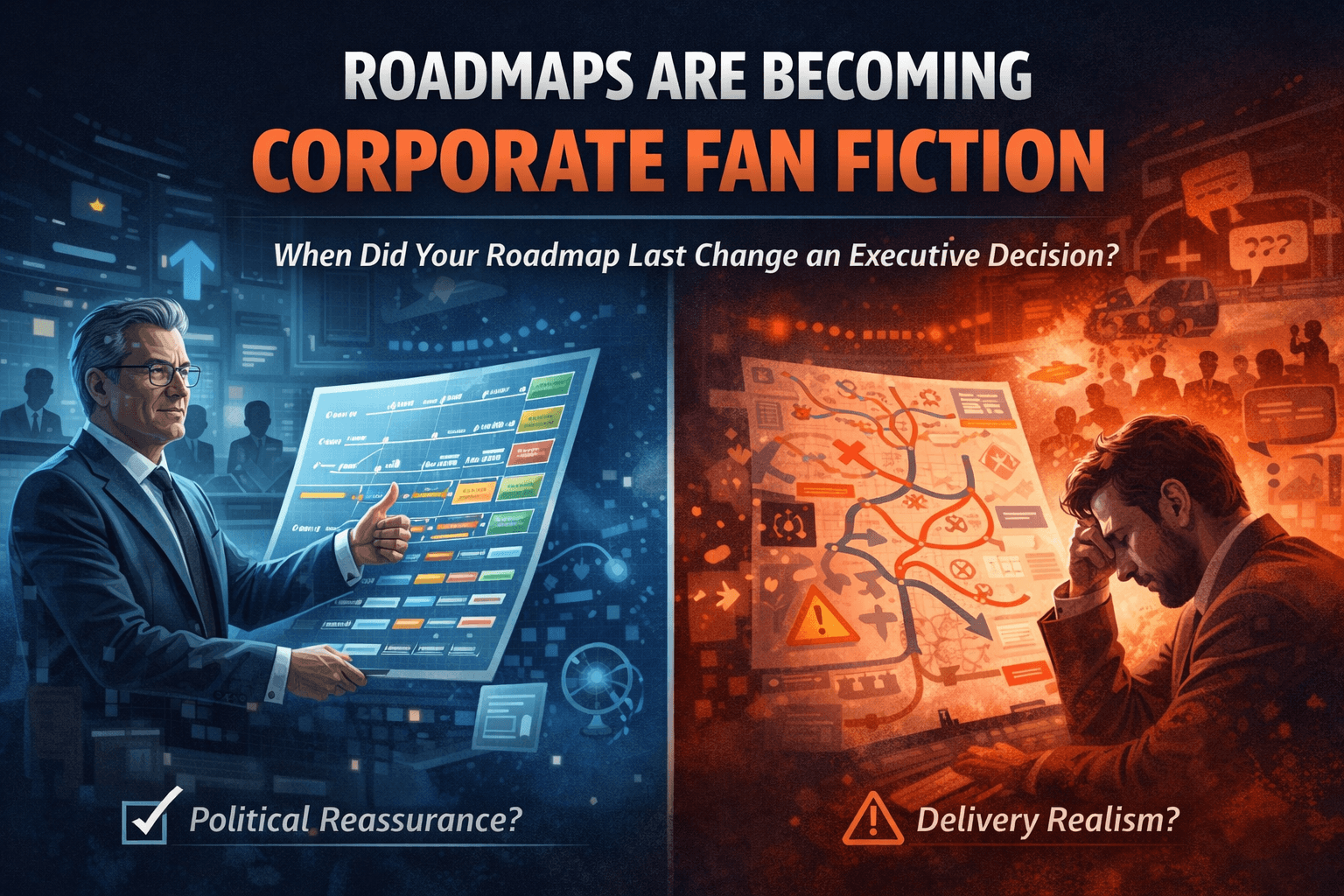
They are political reassurance documents.
They appear in portfolio reviews and board-level strategy sessions: eighteen months of neatly sequenced initiatives, colour-coded by theme, aligned to strategic pillars, and labelled confidently by quarter. The slides look orderly, intentional, and coherent.
And everyone in the room understands — quietly — that large parts of the timeline are aspirational at best and fictional at worst.
The roadmap has not disappeared. It has simply changed purpose. Instead of functioning as a planning instrument, it increasingly acts as a signalling mechanism: a way to demonstrate ambition, reassure stakeholders, and present the appearance of strategic coherence.
In many organisations, the roadmap has become a kind of corporate fan fiction — a compelling narrative about an organisation that does not quite exist, delivering initiatives at a pace it cannot quite sustain.
This is not a niche dysfunction. It is one of the most expensive and under-examined problems in organisational planning.
The roadmap itself is not the problem.
At its best, a roadmap is a genuinely valuable instrument: a structured view of what the organisation intends to do, in what sequence, with what resources, and toward what outcomes. It forces difficult conversations about prioritisation, exposes capacity constraints, and aligns different parts of the organisation around shared assumptions.
Used properly, a roadmap changes decisions.
It tells a portfolio lead that two strategically critical programmes are competing for the same scarce technical resource in Q3, and that one of them will need to move.
It tells an executive team that the transformation agenda they have committed to publicly is not sequenced in a way the organisation can realistically absorb.
It tells a board that the capabilities required for initiative five will not exist by the time initiative three assumes they will.
These are uncomfortable truths.
And that discomfort is precisely why roadmaps often evolve, gradually and unintentionally, into something else.
The executive who pushes back on an honest capacity assessment.
The programme sponsor who insists their delivery date is non-negotiable.
The strategic planning process that builds the roadmap from the top down — starting with the desired outcome and working backward to fill the timeline.
Each pressure is understandable in isolation. Together, they reshape the roadmap into something optimised not for delivery realism but for political palatability.
A roadmap optimised for palatability is not a planning document.
It is a narrative.
Not every roadmap is fictional. Some organisations use them as living instruments that genuinely guide decisions.
But dysfunctional roadmaps tend to share several recognisable characteristics.
A realistic roadmap should show different levels of confidence at different horizons.
The initiative starting next month — with a committed team, resolved dependencies, and a detailed plan — should look very different from the initiative pencilled in for Q4 next year that has a name but little else.
Most roadmaps present both with identical visual certainty.
The same boxes.
The same quarterly labels.
The same implied confidence.
This is not a design choice. It is a distortion of planning maturity.
When everything looks equally planned, leaders cannot distinguish between commitments and aspirations — and they make decisions accordingly.
Roadmaps typically show what the organisation intends to deliver.
They rarely show what it takes to deliver it.
Resource requirements, capability gaps, and the organisation’s capacity to absorb change are usually absent. The cumulative burden of running multiple initiatives simultaneously is almost never visualised.
This silence is not accidental.
Showing capacity alongside ambition forces uncomfortable conversations about trade-offs. It requires programme owners to acknowledge resource competition. It forces executives to prioritise explicitly rather than implicitly.
A roadmap that shows twelve initiatives without showing the people, budget, or organisational bandwidth required to deliver them is not a planning instrument.
It is a wish list with a timeline attached.
A functioning roadmap is a living instrument.
It changes as new information emerges: dependencies shift, priorities move, delivery learning accumulates.
Updating the roadmap should be a sign of planning maturity.
In many organisations, however, roadmaps change only during formal refresh cycles — quarterly, half-yearly, sometimes even less frequently. Between those cycles the gap between the roadmap and reality widens quietly.
A roadmap that has not changed significantly in six months is rarely evidence of planning stability.
More often, it means nobody is being honest about what has changed.
The consequences of fictional roadmaps are substantial, even if they are rarely recognised as such.
When leaders know the roadmap has not been stress-tested against capacity or dependencies, they stop using it as a decision tool.
Instead, conversations drift toward consensus-seeking and escalation avoidance.
From the outside this can look like collaborative leadership. In reality it is often decision paralysis dressed as alignment.
Organisations have a finite capacity to absorb change.
Because that capacity rarely appears in roadmaps, the cumulative burden of overlapping initiatives goes unmeasured. The organisation commits itself to a pace of change that people cannot realistically sustain.
The resulting fatigue, disengagement, and resistance are then attributed to poor change management rather than overconfident planning.
When roadmaps repeatedly fail to reflect reality — when Q3 initiatives slip to the following year or dependencies appear too late — people stop believing them.
Teams stop planning their work around the roadmap. Concerns stop being raised because experience suggests they will not change outcomes.
The roadmap becomes a ritual rather than an instrument.
And the organisation quietly loses one of the planning tools it most needs.
Recovering from roadmap fiction is less a technical problem than a cultural one.
The tools for honest planning already exist. The challenge is creating an environment where honesty is rewarded rather than managed away.
But working roadmaps tend to share a few common characteristics.
They distinguish confidence levels clearly. Near-term commitments look different from medium-confidence initiatives and long-term strategic intentions. Decision-makers can see where the plan is solid and where it is directional.
They show capacity alongside ambition. Initiatives are connected to the people, budget, and organisational change capacity required to deliver them. Trade-offs become visible rather than implied.
They change when reality changes. Dependencies move, priorities shift, and the roadmap moves with them. Updates are driven by delivery reality rather than governance calendars.
And most importantly, they earn trust by acknowledging uncertainty.
Counterintuitively, a roadmap that admits what is not yet known is more credible — and more useful — than one that projects certainty across every horizon.
None of this changes without leadership permission.
Roadmaps become political documents because the surrounding environment rewards confident-looking plans and punishes honest uncertainty.
Programme leads who surface capacity constraints can be labelled obstructive.
Planners who challenge sequencing assumptions can be seen as negative.
PMOs that push back on optimistic timelines can be treated as bureaucratic rather than strategic.
Changing this requires executives who explicitly ask for the honest version.
Leaders who ask not only “are we on track?” but also “what is this roadmap not telling us?”
Leaders who treat a changed roadmap as evidence of good planning rather than poor performance.
The roadmap conversation is ultimately a conversation about planning culture.
One culture uses the plan as a reassurance document.
Another uses it as a decision instrument.
Most organisations claim to want the second.
Most behave in ways that produce the first.
The gap between those two things is where the fan fiction lives.
When did your roadmap last change an executive decision?
Not delay a conversation — actually change a decision.
If the answer takes longer than a few seconds to find, that might be the most useful diagnostic signal you have about your organisation’s planning culture.
Drop your honest answer — or your counterargument — in the comments.